
A beginner’s guide to industrial automation technologies and benefits
Industrial automation plays a growing role in how manufacturers respond to labor shortages, safety concerns, and increasing production demands. Rather than replacing people for the sake of efficiency alone, automation is most effective when it’s applied to repetitive, physically demanding, or consistency-critical tasks that are difficult to sustain manually over time.
This guide introduces the fundamentals of industrial automation, the core technologies involved and the practical benefits they offer in real manufacturing environments. As production lines become more complex and margins tighter, understanding how automation works — and where it makes sense — is increasingly important for anyone new to the field. We’ll cover what industrial automation is, the technologies that support it, common applications in manufacturing, and how beginners can start building a working understanding of this discipline.

What is industrial automation and how does it work?
Industrial automation refers to the use of control systems, robotics, and integrated machinery to operate manufacturing processes with reduced manual intervention. In practice, automation allows production to run more consistently, safely and predictably, especially in environments where manual processes struggle to keep pace or introduce unnecessary risk.
Automation systems rely on coordinated hardware and software to monitor conditions, make decisions, and execute physical actions. These systems don’t operate in isolation; they are designed to fit within existing production lines and workflows, often alongside human operators.
Defining industrial automation and its key components
Industrial automation brings together mechanical systems, robotics, and controls to improve how products move through a manufacturing process. At Versatech, automation is designed around real production environments where variation, uptime and safety matter just as much as speed.
Key components include:
- Robotics: Industrial robots that handle tasks like assembly, inspection, and material handling with consistent speed and accuracy. These robots are paired with application-specific end-of-arm tooling designed to handle each product reliably.
- Sensors and vision systems: Sensors and machine vision provide real-time feedback on part presence, position, and quality, allowing automated systems to adapt to normal production variation rather than relying on perfectly staged inputs.
- Control systems: PLCs, HMIs, and industrial networks that coordinate robots, conveyors, and safety systems into a single, integrated line designed for long-term reliability and ease of support.
Together, these components form complete automation systems that improve throughput, reduce manual handling, and integrate cleanly with existing equipment.
Which automation technologies should beginners know?
For those new to industrial automation, understanding the core technologies is a useful starting point. While individual components matter, it’s equally important to recognize how these technologies work together as part of a broader system.
Overview of robotics in manufacturing basics
Robotics plays a central role in many automated manufacturing systems. Different robot types are suited to different applications based on payload, speed, reach and precision.
- Industrial Robots: High-speed, high-payload robots often used for pick-and-place, assembly, and insertion tasks where repeatability and cycle time are critical.
- Collaborative Robots (Cobots): Robots designed to operate with built-in safety features that may allow closer interaction with operators in appropriate applications. While useful in certain scenarios, cobots are not a universal replacement for traditional industrial robots and must be evaluated carefully based on production demands.
Understanding the strengths and limitations of each robot type helps beginners recognize why robot selection is application-specific rather than one-size-fits-all. The unique safety features of collaborative robots, as discussed, are further elaborated upon in research highlighting their design to work safely alongside human operators.
Collaborative Robots: Enhancing Safety in Industrial Automation
Until now, industrial robots have always been fast and robust devices that work on specific tasks designed for them. To stay in accordance with the aforementioned rule they were performing behind fixed and interlocked guards and sensitive protective equipment to prevent human intrusion into their workspace. With the introduction of collaborative robots the cages are omitted as those robots are designed to work with humans. They are built with different safety features to prevent collisions, but if a collision occurs, the mechanism will move in the opposite direction or stop completely to avoid causing injury.
Collaborative robots, M Mihelj, 2018
Introduction to industrial control systems explained
Industrial control systems (ICS) manage how automation equipment operates, communicates, and responds to changing conditions. These systems form the backbone of automated production.
- Programmable Logic Controllers (PLCs): PLCs are the primary controllers used to automate specific processes such as assembly, material handling, and packaging operations.
- Supervisory Control and Data Acquisition (SCADA): SCADA systems provide higher-level monitoring and control, often across multiple processes or systems within a facility.
- Distributed Control Systems (DCS): Used in more complex or continuous processes, DCS platforms allow centralized control across distributed equipment.
For beginners, understanding that these systems prioritize reliability, safety, and maintainability, not just functionality, is critical to understanding how automation operates in real production environments.
Further emphasizing the foundational role of these control systems, one study highlights their evolution and impact on modern industrial processes.
PLCs, SCADA, and DCS: Core Industrial Automation Technologies
The programmable Logic Controller (PLC) is the central controlling unit in the industry or a process. The effective operation of the process and safety considerations if programmed appropriately can meet the required objectives. The present technical paper briefly distinguishes the present automation systems and the past technologies to identify and explore the capabilities of PLCs for any process. The relay logic and contactor logics (RLC) were practiced in the olden days which include the human intervention and errors. The advent and application of microprocessors, microcontrollers and new specific tools such as PLCs, Supervisory control and data acquisition (SCADA) and Distributed control systems (DCS) have increased productivity, accuracy, precision and efficiency. These systems reduced human intervention and increased the flexibility in the process control.
Programmable logic controller (PLC) in automation, MG Hudedmani, 2017

What are the main benefits of industrial automation?
When applied appropriately, industrial automation delivers practical benefits that extend beyond speed alone. These benefits are often tied directly to production stability, labor availability, and workplace safety.
How automation improves efficiency and productivity
Automation helps manufacturers maintain consistent output by reducing variability introduced by manual processes. Key productivity benefits include:
- Increased production consistency: Automated systems perform tasks the same way every cycle, supporting predictable throughput and repeatable quality.
- Improved process control: Automation allows tighter control over timing, positioning, and sequencing, which reduces rework and process drift.
- Labor optimization: By shifting repetitive or physically demanding tasks to machines, skilled labor can be reassigned to higher-value work rather than eliminated outright.
These improvements help stabilize production rather than simply push for maximum speed.
Impact of automation on safety and cost reduction
Automation is also a practical tool for improving safety and controlling long-term operating costs.
- Enhanced safety: Automated systems reduce exposure to heavy lifting, repetitive motion, and hazardous environments by removing people from high-risk tasks.
- Lower operational risk: Consistent automated processes reduce errors that can lead to scrap, downtime, or equipment damage.
- Energy and resource efficiency: Well-designed systems minimize unnecessary motion, rework, and wasted energy, contributing to more efficient operation over time.
These benefits highlight the importance of automation in creating a safer and more cost-effective manufacturing environment.
How can beginners start learning about industrial automation?
For those entering the field, industrial automation is best understood through a combination of technical knowledge and hands-on exposure to real systems.
Essential skills and knowledge for automation beginners
Beginners should focus on acquiring the following skills:
- Technical Skills: Basic understanding of robotics, control systems, sensors, and mechanical integration.
- Problem-Solving Skills: Automation work often involves diagnosing issues in complex systems rather than following fixed procedures.
- Analytical Skills: Recognizing how individual components interact within a full production line is just as important as understanding each component on its own.
Recommended resources and training options
Beginners can build foundational knowledge through a mix of formal education and practical experience:
- Technical courses and certifications: Courses covering PLCs, robotics, and controls provide useful fundamentals.
- Plant-floor exposure: Hands-on experience with operating equipment offers insight that can’t be learned from diagrams alone.
- Industry resources: Technical documentation, application examples, and integrator case studies help bridge theory and practice.
Learning industrial automation is an ongoing process, shaped as much by real-world problem solving as by formal training.

What are common applications of robotics in manufacturing?
Robotics is commonly applied where consistency, speed, or safety are difficult to achieve manually. These applications span a wide range of industries and production environments.
Examples of robotics we use at Versatech
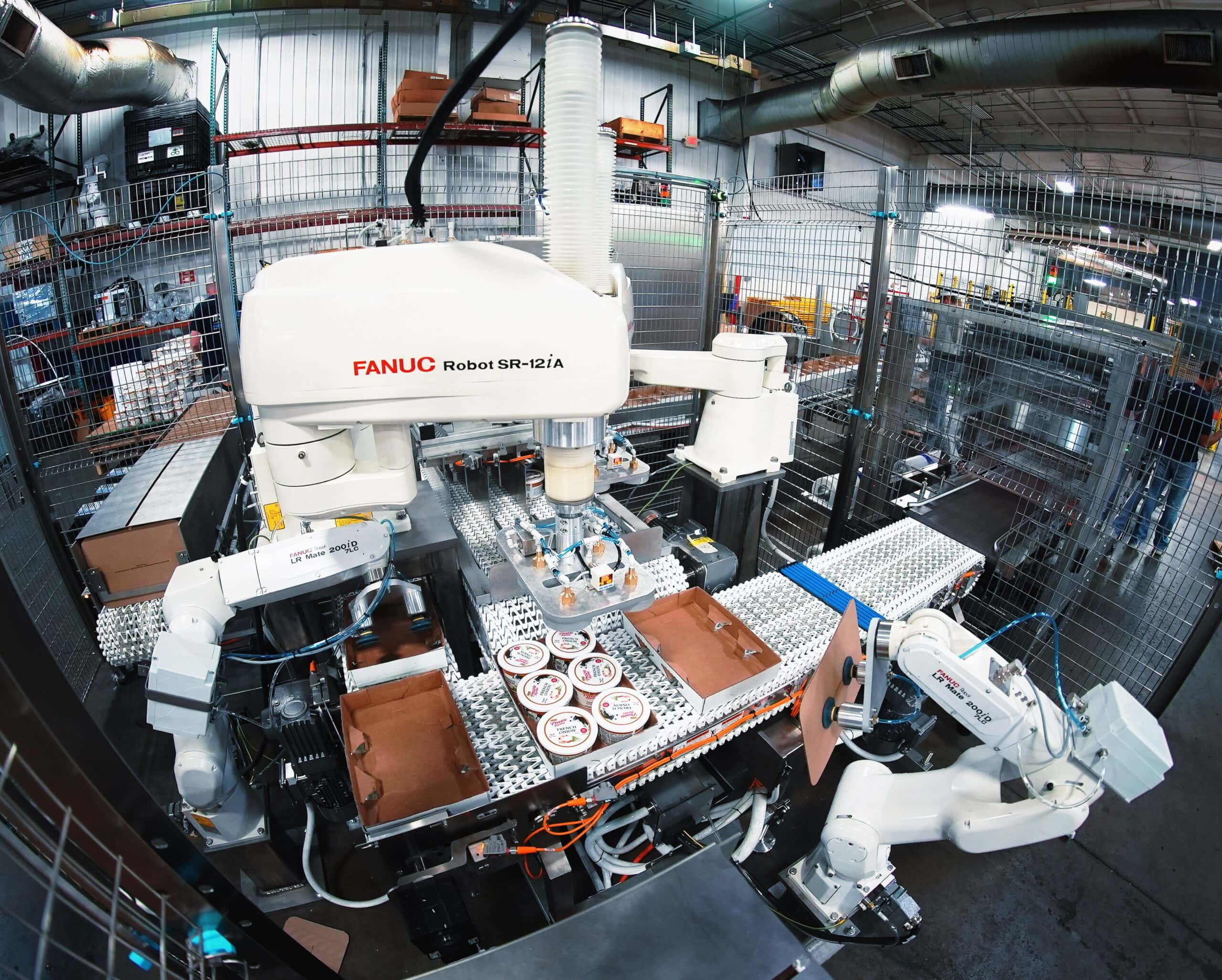
Robots are widely used in Versatech systems to handle tasks that demand consistency, accuracy, and repeatability in real production environments. Rather than deploying robots in isolation, these applications are designed as part of fully integrated systems that work alongside conveyors, tooling, vision, and controls.
Automated assembly:
Robots perform assembly tasks such as part placement, fastening, insertion, and orientation with consistent force and positioning. This reduces cycle time and variation compared to manual assembly, while also minimizing repetitive motion and ergonomic strain for operators. Assembly systems are typically paired with custom end-of-arm tooling and, where needed, vision systems to account for normal part variation.
Quality control and verification:
Robots equipped with machine vision inspect parts for presence, orientation, completeness, or defects before they move downstream. These inspections happen in-line and at production speed, allowing quality checks to be built into the process rather than handled as a separate manual step. When issues are detected, systems can reject parts automatically or alert operators for intervention.
Material handling and part transfer:
Robots move products between processes, load and unload equipment, and manage part flow through a line. This helps stabilize throughput, reduce manual lifting, and maintain consistent pacing between upstream and downstream operations.
Packaging and end-of-line handling:
Robotic systems handle tasks such as case packing, palletizing, and product staging, where consistency and uptime are critical. These applications are often the final step in the line and play a key role in relieving labor pressure and reducing injury risk.
Together, these applications show how Versatech uses robotics to support complete manufacturing systems to improve reliability, product quality, and long-term operability rather than simply automating individual tasks.
Future trends in robotics for industrial automation
The future of robotics in industrial automation is promising, with several trends emerging:
- Improved sensing and vision: Smarter sensors and vision systems allow robots to handle greater product variation.
- Expanded human-machine interaction: Automation systems are increasingly designed to coexist with operators rather than isolate them completely.
- Greater system integration: Future automation emphasizes line-level coordination and lifecycle support over standalone equipment.
These trends reflect a shift toward automation that is more flexible, serviceable, and aligned with real production needs.
Conclusion
If you’re new to industrial automation, the most important thing to understand is that it’s not just about robots or software. It’s about how systems work together to support real production.
This guide is meant to give you a starting point — a way to understand the core technologies and how they’re applied on the plant floor. Automation works best when it’s designed around actual constraints rather than ideal conditions.
That’s how Versatech approaches every system: as a practical, integrated solution built to run reliably over time. With a solid grasp of these fundamentals, beginners are better equipped to recognize where automation fits, ask better questions, and make informed decisions as they move forward.


